When I first found this activity, all I could think about what PSAT's, SAT's, ACT's, and any other kind of standardized test that you can think of. You know, when they have you read a story and the you have to correctly identify the point of the story, and various aspects about it? Yeah... I was never did excell at those kinds of tests, which is interesting because I love to read. But regardless of the tests, this activity is still fun for kids, and could actually make a great party game.
What you are going to do is tell a story with lots of descriptive words. If you don't have a story like this on hand, here is how to write one. If doing it for a birthday party, you could write a story about the birthday kid and do it as one of your games.
Before you begin the story, have the child or children clothes their eyes and focus really hard on listening (use their big ears!). Then tell the story, remind the kids to listen for descriptive words (you may want to explain what a descriptive word is at the start of the activity). Once the story is over, you can do a number of things.
1. Have the kids write down the answers to your questions
2. Draw pictures of the objects that they remember (pink dress, blue eyes, etc)
3. Have the kids try to retell the story (you can have one kid do this, or have kids take turns after a few sentences each)
4. Have costumes and things on hand to act out the story.
5. Have coloring pages for the kids to color correctly (again, pink dress, blue eyes, etc)
6. Whatever else you can think of.
That's about it! I would advise keeping the stories fairly short depending on the age and skill level of your kids. And the more you do it, the more you can add to the stories. You could even grab some library books and then add more descriptive words if you like. OOH! Or how about
Have you done any thing like this? Do you have a descriptive story to share or recommend?
Showing posts with label Games. Show all posts
Thursday, March 20, 2014
Friday, February 28, 2014
Family Newsletter!
I am super excited to do this one with my daughter and husband. It's kind of like sending out Christmas letters, but could include a lot more. You could essentially use any program from Word, to Open Office, or an actual Newsletter construction program.
Here are a few suggestions (I have not tried them personally, so use discretion when you choose one)
Word (Click this link for instructions)
Publisher (LINK)
Word Draw (LINK)
Smile Templates (LINK)
And now here's the hard part. You may be like me and want to share your news with family and friends all the time, in newsletter form, because somehow, it makes you feel important. Well I'm going to put the kabash on that idea right away! Who has time to write newsletters constantly? May I suggest that you stick to Easter and Christmas? Or perhaps for each person's birthday? (This is an EXCELLENT way to start a family history book, btw). The choice is yours, but from personal experience, I would say to be careful not to take on too much. It's easier to start small, and do more newsletters later than to attempt a lot all at once. And now for the second hardest thing. Choosing what to include....
Choosing what to include will have a large bias depending on how many people you have in your family. If you and your husband have 5 kids, you might want to forgo drawings by the kids, whereas if you have one child, you will likely have space to include it. The choice is yours, but here are some ideas.
Recent pictures (any snapshot is fine)
Upcoming dates of importance (Dance Recitals, Graduation, Birthday Party, etc)
Current Address and Phone number (especially important if you recently moved like we did)
Family News (Graduations, births, etc)
Special successes (Aced a test, job promotion, etc)
New house (Or apartment, condo, garden, etc)
Family History/Genealogy story
Stories written by the kids
Pictures drawn by the kids
Family Vacation Summary (with pictures)
Favorites (Family Recipe, Game, Book, Activity, etc. You could also do this for birthday newsletters)
The options are limitless. And if you feel overwhelmed, just think what you would tell someone that you hadn't seen in years, and you were catching up over lunch. Start with that, and build from there.
Good luck with everything! Don't worry about it being perfect, especially in the beginning. My daughter's birthday is coming up, so I'm going to make a newsletter for her to send to family and close friends. What kind of newsletter would you try?
Here are a few suggestions (I have not tried them personally, so use discretion when you choose one)
Word (Click this link for instructions)
Publisher (LINK)
Word Draw (LINK)
Smile Templates (LINK)
And now here's the hard part. You may be like me and want to share your news with family and friends all the time, in newsletter form, because somehow, it makes you feel important. Well I'm going to put the kabash on that idea right away! Who has time to write newsletters constantly? May I suggest that you stick to Easter and Christmas? Or perhaps for each person's birthday? (This is an EXCELLENT way to start a family history book, btw). The choice is yours, but from personal experience, I would say to be careful not to take on too much. It's easier to start small, and do more newsletters later than to attempt a lot all at once. And now for the second hardest thing. Choosing what to include....
Choosing what to include will have a large bias depending on how many people you have in your family. If you and your husband have 5 kids, you might want to forgo drawings by the kids, whereas if you have one child, you will likely have space to include it. The choice is yours, but here are some ideas.
Recent pictures (any snapshot is fine)
Upcoming dates of importance (Dance Recitals, Graduation, Birthday Party, etc)
Current Address and Phone number (especially important if you recently moved like we did)
Family News (Graduations, births, etc)
Special successes (Aced a test, job promotion, etc)
New house (Or apartment, condo, garden, etc)
Family History/Genealogy story
Stories written by the kids
Pictures drawn by the kids
Family Vacation Summary (with pictures)
Favorites (Family Recipe, Game, Book, Activity, etc. You could also do this for birthday newsletters)
The options are limitless. And if you feel overwhelmed, just think what you would tell someone that you hadn't seen in years, and you were catching up over lunch. Start with that, and build from there.
Good luck with everything! Don't worry about it being perfect, especially in the beginning. My daughter's birthday is coming up, so I'm going to make a newsletter for her to send to family and close friends. What kind of newsletter would you try?
Wednesday, February 19, 2014
Activity: Going on a WORD picnic
This activity is an excellent option for those that want to help their kids learn vocabulary, rhyming, sounding, etc., without putting too much pressure on them. And the best part is that all you need to do is set up a picnic....
Spread out the blanket, put the food in a basket or on trays, and get ready to be creative. If you pull a sandwich out of the basket, have your child think of another word that starts with the same sound as sandwich. The child will need to realize that sandwich starts with an S sound, and then think of another word that begins with S. You could also do a rhyming variation and pull out BREAD, and have your child think of a rhyme (dread, bed, dead, Fred, read, red, etc).
An activity like this could also be used outdoors in the summer to keep ideas fresh in the children's minds, even though they aren't in school. So what do you think? Have you played a game like this? How did it go?
Spread out the blanket, put the food in a basket or on trays, and get ready to be creative. If you pull a sandwich out of the basket, have your child think of another word that starts with the same sound as sandwich. The child will need to realize that sandwich starts with an S sound, and then think of another word that begins with S. You could also do a rhyming variation and pull out BREAD, and have your child think of a rhyme (dread, bed, dead, Fred, read, red, etc).
An activity like this could also be used outdoors in the summer to keep ideas fresh in the children's minds, even though they aren't in school. So what do you think? Have you played a game like this? How did it go?
Monday, February 17, 2014
Activity: I Spy Variations
I spy with my little eyes something... Red! Blue? Green? Plaid?
Instead of playing the regular eye spy where you spy colors, how about trying something else like this...:
I spy with my little eye something that is a triangle....
I spy with my little eye something dark....
I spy with my little eye something that moves....
I spy with my little eye an animal....
And if you are at a crowded place like a McDonald's Play Place, the mall, etc. try some of these:
I spy with my little eye someone who is dancing....
I spy... someone who is sleeping....
I spy... someone talking on their cell phone....
In any case, you can be as creative as you want with this game. You could even do it between rain showers when the clouds are all puffy. Whichever way you do it, have fun!
Have you done a game like this? What variations did you do?
Instead of playing the regular eye spy where you spy colors, how about trying something else like this...:
I spy with my little eye something that is a triangle....
I spy with my little eye something dark....
I spy with my little eye something that moves....
I spy with my little eye an animal....
And if you are at a crowded place like a McDonald's Play Place, the mall, etc. try some of these:
I spy with my little eye someone who is dancing....
I spy... someone who is sleeping....
I spy... someone talking on their cell phone....
In any case, you can be as creative as you want with this game. You could even do it between rain showers when the clouds are all puffy. Whichever way you do it, have fun!
Have you done a game like this? What variations did you do?
Wednesday, January 29, 2014
Activity: Charades
I happen to love Charades. I've played it as a kid, at birthday parties, college parties, etc., and I still love it. And the best part about it, is that it is very adaptable to various age groups and situations. All you need to do is have a list of things that the kids can act out. I like putting the items on slips of paper, so that the kids can draw one out of a hat. Here are some categories that might work well for kids:
Animals (farm, circus, jungle, etc.)
Things in Nature (leaves, trees, raindrops, etc)
People (pretend to be each other)
Action words (jump, run, skip, roll, etc.)
Vehicles (Car, train, airplane, etc.)
Body Parts (just have them point to their body parts and have people guess)
Facial Expressions (happy, sad, mad, bored, etc.)
There are of course many other categories that you can come up with. And you may need to allow kids to make noise, instead of remaining silent like we do as adults.
Mia, as an almost two year old would do really well at pointing to body parts, but she's not quite ready for the other categories. So as you plan the game, make sure that the options are appropriate for the age group.
Have you tried this with your kids? What words or categories did you use?
Animals (farm, circus, jungle, etc.)
Things in Nature (leaves, trees, raindrops, etc)
People (pretend to be each other)
Action words (jump, run, skip, roll, etc.)
Vehicles (Car, train, airplane, etc.)
Body Parts (just have them point to their body parts and have people guess)
Facial Expressions (happy, sad, mad, bored, etc.)
There are of course many other categories that you can come up with. And you may need to allow kids to make noise, instead of remaining silent like we do as adults.
Mia, as an almost two year old would do really well at pointing to body parts, but she's not quite ready for the other categories. So as you plan the game, make sure that the options are appropriate for the age group.
Have you tried this with your kids? What words or categories did you use?
Activity: Hot or Cold
This is a super easy game that I am sure many of us played when we were younger. Here's what to do in case you aren't familiar with it.
Take an object and hide it, when the "Seeker" closes their eyes or leaves the room. When they open their eyes, have them search for the object, while you tell them if the are "hot", "warm", or "cold". Hot means that you are very close to the object, warm means you are getting closer, and cold me that you are not close to it. Make sure that you take turns and allow the kids the change to give the directions as well.
Have you played this game? How did it work with different ages?
Take an object and hide it, when the "Seeker" closes their eyes or leaves the room. When they open their eyes, have them search for the object, while you tell them if the are "hot", "warm", or "cold". Hot means that you are very close to the object, warm means you are getting closer, and cold me that you are not close to it. Make sure that you take turns and allow the kids the change to give the directions as well.
Have you played this game? How did it work with different ages?
Activity: A new kind of hide and seek
Hide and seek is always fun for kids, but as an adult, I either get bored quickly, or worry that the kids are going to hide somewhere crazy or dangerous, and then fall asleep and I won't know where to find them. Needless to say that I was thrilled when I heard about a "NEW kind of hide and seek". Here's how it works:
You take an object (toy car, doll, boat, action figure, etc). and while the person who is "it" closes their eyes, you hide it somewhere in the room. (This next part of the description comes straight from the website http://www.education.com/activity/article/hoppeduphide_preschool/).
"Give simple but very specific directions to guide your child in finding the object. A typical game might include: "Walk three steps forward." "Turn toward the window." "Walk five steps forward." "Walk two more steps forward." Or throw in some colors, like "look next to something red." At first, allow the child to complete a direction before giving them another one."
You can of course make the direction easier, or more complex depending on the age and understanding of the child. And then after the child has found the object a few times, allow them to hide it and you to seek it!
We tried this today with Mia and her cousins. It was a lot of fun for her 5 year old cousin Brooklyn, although Mia and Jenna didn't quite understand what was going on. So this activity would probably be better for kids 2 1/2 and up. But of course, that's just a generalization.
Have any of you tried this activity or one similar to it? How did it go?
You take an object (toy car, doll, boat, action figure, etc). and while the person who is "it" closes their eyes, you hide it somewhere in the room. (This next part of the description comes straight from the website http://www.education.com/activity/article/hoppeduphide_preschool/).
"Give simple but very specific directions to guide your child in finding the object. A typical game might include: "Walk three steps forward." "Turn toward the window." "Walk five steps forward." "Walk two more steps forward." Or throw in some colors, like "look next to something red." At first, allow the child to complete a direction before giving them another one."
You can of course make the direction easier, or more complex depending on the age and understanding of the child. And then after the child has found the object a few times, allow them to hide it and you to seek it!
We tried this today with Mia and her cousins. It was a lot of fun for her 5 year old cousin Brooklyn, although Mia and Jenna didn't quite understand what was going on. So this activity would probably be better for kids 2 1/2 and up. But of course, that's just a generalization.
Have any of you tried this activity or one similar to it? How did it go?
Saturday, November 16, 2013
This game is fun for kids THROUGH adults!
Many years ago, I went to a birthday party and played an interesting game that involved paper clips and baby food jars. While I was at the dollar store yesterday, I came up with an idea that works better for younger children (Scroll to the bottom to find different instructions for older kids/adults). Here's what you need:
Items:
Glass rocks (I got mine from the dollar store. You can also get them at Walmart, craft stores, or other places that sell fake flowers).
A bucket, Tupperware, jar, etc. (I would recommend 1 per kid)
WARNING: Do NOT attempt this activity if you have a migraine, headache, are irritable, or have kids that put things into their mouths.
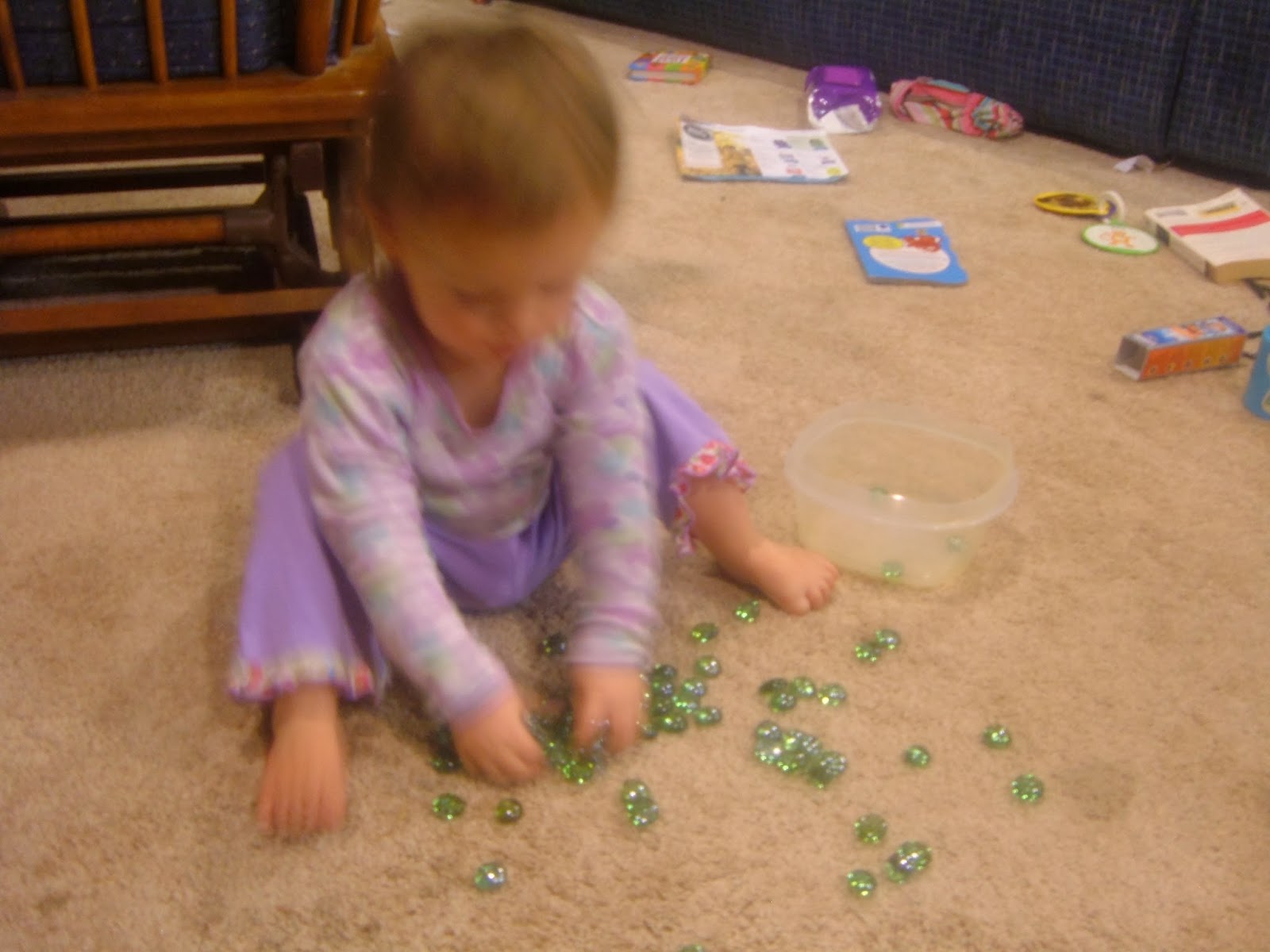
So the point of this activity can actually change depending on the age group you're dealing with. For Mia, and other kids under three, we just dropped the glass rocks into the Tupperware after raising them above our heads.
Items:
Glass rocks (I got mine from the dollar store. You can also get them at Walmart, craft stores, or other places that sell fake flowers).
A bucket, Tupperware, jar, etc. (I would recommend 1 per kid)
WARNING: Do NOT attempt this activity if you have a migraine, headache, are irritable, or have kids that put things into their mouths.
| Dollar store rocks and an old Tupperware. |
So the point of this activity can actually change depending on the age group you're dealing with. For Mia, and other kids under three, we just dropped the glass rocks into the Tupperware after raising them above our heads.
Mia quickly decided that she wanted to change all of the rules. She had a lot more fun running her fingers through the rocks and making noise. Some of the rocks still made it into the Tupperware though.
All in all, this activity produced one happy kid. :)
Older Kids (at least ages 3+): The point of the game is to drop objects (rocks, paperclips, etc) into jar of varying width openings, and from varying heights off the ground. And for this activity you will need more than just the object listed above.
Items Needed:
Glass Rocks, Paperclips, etc. (To make it fair, choose just one item that will be the same for everyone).
Tupperware, empty baby food jars, large glass jars, buckets, paper bags, etc. (for each round, everyone uses the same "container"
A chair, step stool, etc.
A piece of paper to keep score
The point of the game is to get the item (paperclip, glass rock, etc) into the smallest hole from the highest height.To start the game, everyone needs to stand in a line until it is their turn. The first person sits on the floor, holds the object (rock, paper clip, etc) at chin level, and then drops it into the "container". If it lands in the container, then they get to move to the next round. Each person does the same thing on their turn. You are allowed to lean forward a little (no major bending at the waist - you will need to decide how far is ok for your age group). The rest of the game is supposed to get a little harder each round. So if you start with a large bucket, I would suggest a large Tupperware next. Then perhaps a paper bag and a smaller bucket, and finally on down to the baby food jar. Another variation would be to increase the height that you are dropping from, which is why you would need a step stool, or a chair.
Subscribe to:
Posts (Atom)